
The history of trading is linked to that of energy and vice versa. Trade requires the transfer of goods or services, which needs all sorts of energy.
You can transport goods by galleys using human energy from rowing, or sailing ships using wind energy as well as steamships run by coal-generated thermomechanical energy.
The first coal mines were worth more if they were close to water or ports; however, these mines were also more prone to flooding risks. Steam engines were the first
solution for this problem, more or less the same engines were then used in marine transport.
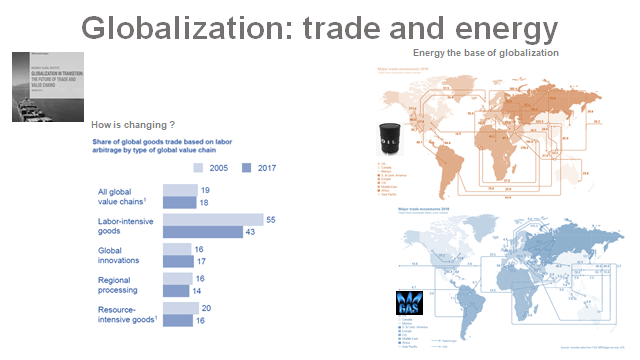
On the left side of this slide we have some data from a recent Mckinsey report about trade and globalization. The report present the change in trade intensity comparing 2000-2007 versus 2007-2017.
In the other blu graph below, it is possible to observe the reduction related to labour intensive goods
Trade intensity defined as gross exports as a percentage of gross output.
Globalization reached a turning point in the mid-2000s, although the changes were obscured by the Great Recession.
less than 20 percent of goods trade is based on labor-cost arbitrage, and in many value chains, that share has been declining over the last decade.
The fourth and related shift is that global value chains are becoming more knowledge-intensive and reliant on high-skill labor.
Across all value chains, investment in intangible assets (such as R&D, brands, and IP) has more than doubled as a share of revenue, from 5.5 to 13.1 percent, since 2000.
 neON news/energy/ON