
Il principale produttore e consumatore di petrolio ha esportato 89.000 barili al giorno in più di greggio e prodotti raffinati rispetto a quanto importato a settembre, il primo mese intero di una bilancia commerciale positiva dal 1940, secondo quanto riferito da Energy Information Administration. Le importazioni hanno superato le esportazioni di 12 milioni di barili al giorno un decennio fa.
Access to Energy
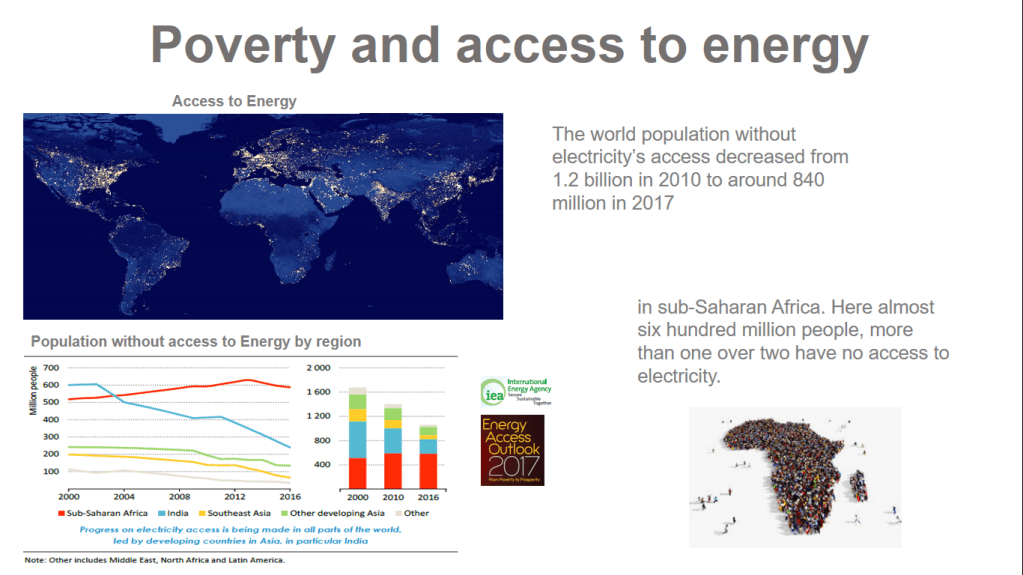
Growth has not been the same everywhere: today many countries still lag behind. However, if we concentrate over the last decade we can say that we had a strong progress. Perhaps we expanded access to electricity in several countries, such as India, Bangladesh and Kenya. The world population without electricity’s access decreased from 1.2 billion in 2010 to around 840 million in 2017 (over a world population more than 7 billions).
Although the number of people without energy access is decreasing, the battle to end poverty is not finished yet… long story short, those who still do not have access are still numerous and are mainly in sub-Saharan Africa. Here almost six hundred million people, more than one over two have no access to electricity.
Lest you forget the population without access to clean cooking, almost 3 billion (in 2016) mainly distributed in Asia and Africa. Even worse if we consider data from the International Energy Agency, related the 2.5 million premature deaths each year, due to household air pollution. The use of fuels and cooking polluting technologies represent a challenging socioeconomic issue. It feeds inequality exponentially: among poor, the women are the most suffering. Indeed, in developing countries, women take care of cooking fuel, as well as cooking itself. The IEA in a report (2017) estimated that every day women lost almost 6.5 hours for these activities.
 neON news/energy/ON